
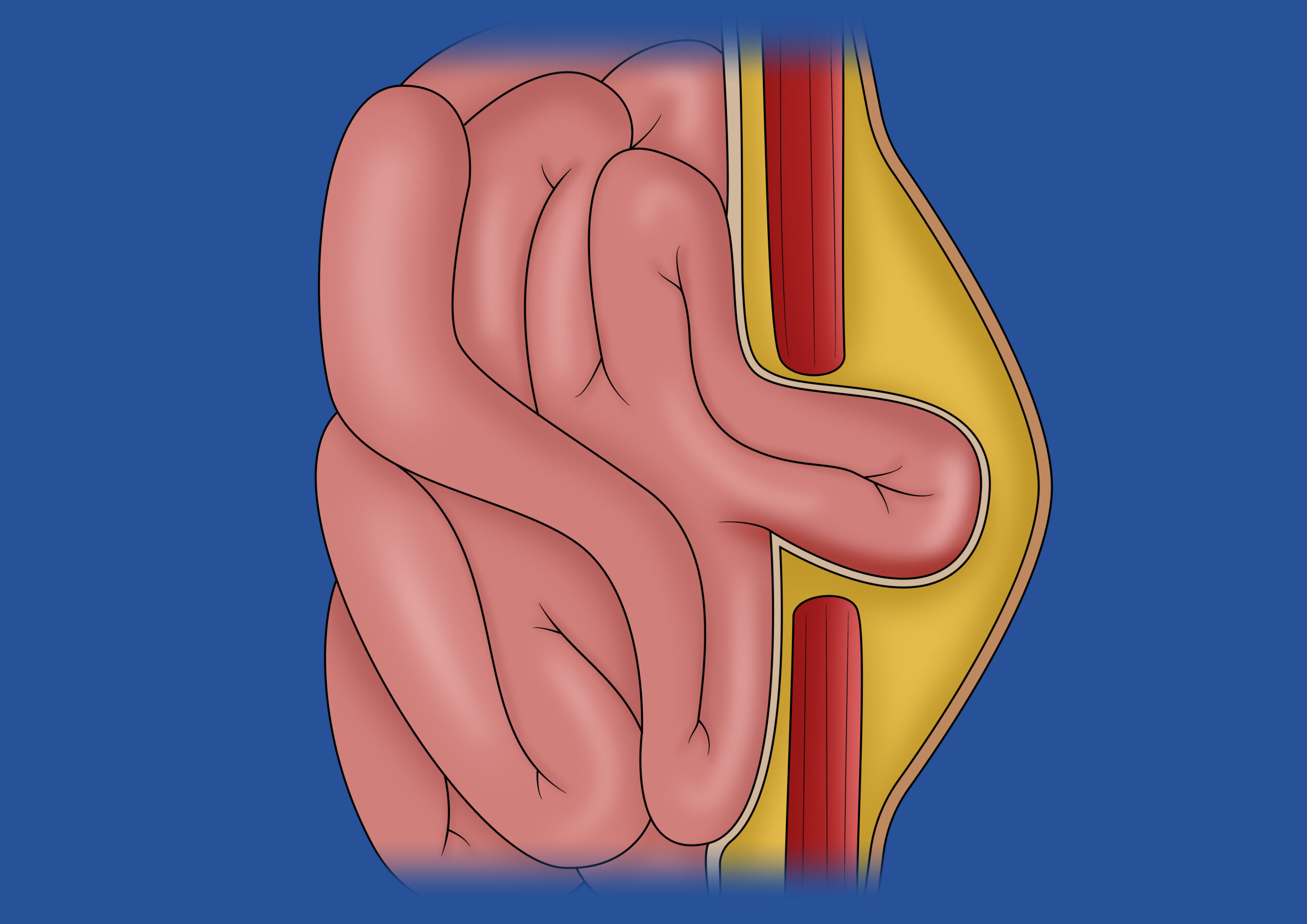
Umbilical Hernia
Umbilical Hernia | Hernia umbilicalis | umbilical hernia
For the surgical treatment of umbilical hernias, I utilize modern procedures (DaVinci). All techniques aim to optimally repair the hernia using a synthetic mesh, minimize scarring, and thereby reduce postoperative pain.
Two-Column Text
- Direktverschluss (Operationsdauer ca 45min)
Ohne Netzeverstärkung bei <1cm im Durchmesser großen Defekten - Preperitoneal Umbilical Mesh Plasty – PUMP or Robotically-Assisted Ventral TAPP (Operating time approx. 60 min)
The PUMP technique is employed for hernias smaller than 1 cm. In this procedure, the synthetic mesh is placed with a 2-3 cm overlap beyond the defect, positioned between the peritoneum and the abdominal wall. This approach prevents complications such as adhesions to abdominal organs.
- (e)MILOS or Robotically-Assisted TARUP or rTEP Technique (Operating time from 120 min)
For larger umbilical hernias, the endoscopically-assisted MILOS or the robotically-assisted TARUP or TEP method is utilized. The synthetic mesh is positioned beneath the abdominal musculature. The operation is performed laparoscopically or robotically-assisted using the DaVinci Xi System. - Intraperitoneal Onlay Mesh – Robotically-Assisted IPOM Plus (Operating time approx. 120 min)
The (r)IPOM plus technique is a robotically-assisted procedure where the hernia defect is closed and a synthetic mesh is sutured to the peritoneum. The robot-assisted PeTEP technique (preperitoneal extended totally extraperitoneal) (surgery duration approx. 120 min) is a modern, minimally invasive method for treating small to medium-sized abdominal wall defects. I prefer to use a so-called “bottom-up” approach from the lower abdominal region, which allows for anatomical reconstruction of the abdominal wall while minimizing stress on the patient. A particular advantage of this technique lies in the cosmetic outcome: The incisions are located in the so-called bikini line and are therefore barely visible later on. In addition to the functional restoration of the abdominal wall, this also achieves a highly aesthetically pleasing result.